
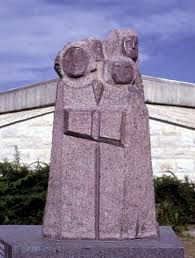
A monument to the four hanged women at Yad Vashem, Jerusalem, Israel.
Sculpted by Joseph Salamon. Photo by the artist.
This week we remember four brave Jewish young women who were murdered in Auschwitz-Birkenau in an extraordinary manner. Soon after the new year began in 1945, Ala Gertner, Roza Robota, Regina Safirstajn, and Ester (Estusia) Wajcblum were publicly hanged before the assembled women’s camp during the first week of January 1945. They had been caught smuggling gunpowder from the Weichsel-Union-Metallwerke munitions factory, where three of them were slave laborers, to the men of the Sonderkommando in Birkenau. The small amounts of gunpowder were intended to help blow up Krematorium IV during the October 1944 Sonderkommando uprising.
In the spring of 1943, Ester, Regina, and Ala had been assigned to work in the Union factory. Roza, who worked in the Auschwitz-Birkenau clothing depot, enlisted them and others. Roza, Ester, and some of the other young women had been members of the Hashomer Hatzair youth group. About thirty women and girls have been identified as playing roles in the operation, and there may have been more.
These four Jewish female resistance fighters were caught and then singled out for this unusual form of execution on direct orders from Berlin, only weeks before the camp’s liberation. They were tortured but refused to implicate their accomplices.
Just as the story of this courageous deed is often left out of the Auschwitz-Birkenau narrative, women’s experiences have frequently been omitted from Holocaust history and history in general. Remember the Women Institute’s mission is to ensure that women’s stories are told and integrated into history.