
Hannah Senesh, Haviva Reik, and Sara Braverman set out to parachute into Europe on behalf of their brothers and sisters living under Nazi rule. Of the three, only Sara survived. This is her story.
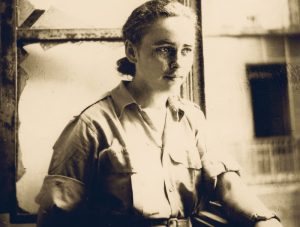
Sara Braverman, 1944. Photo: Nadav Mann, Bitmuna. From the Rafael Reiss Collection. Source of collection: Edna Reiss Leshem, the Pritzker Family National Photography Collection, the National Library of Israel
Just before Sara Braverman, who often went by the nickname Surika, was due to make her final qualifying jump at the end of her parachute training, she froze. Even when her friends, including her close companion Haviva Reik, offered to jump alongside her on a second attempt, she could not bring herself to leap from the aircraft. That was how she earned the title, “the paratrooper who didn’t jump.”
Yet despite never making that jump, Sara, who was highly regarded by her British commanders, completed the course and was sent to Europe alongside Reik and other volunteers as part of the second mission of the “Yishuv Paratroopers” (Yishuv is a Hebrew term for the Jewish community in pre-state Israel). She was one of only three women selected for the operation. In addition to Sara and Haviva, the first mission included the most famous of the paratroopers: Hannah Senesh. Ironically, Braverman, the one who had been afraid to jump during training, would be the only one of the three women to return home alive.
Braverman was born in May 1919 in Romania to a secular family of modest means. Her father was a committed socialist and thoroughly secular, while her mother came from a religious background. The household itself was secular, but also deeply Zionist. Like most of her siblings, Sara was active in the Hashomer Hatzair youth movement, where she quickly distinguished herself through her dedication and leadership. She was selected to immigrate to Palestine as part of a group of outstanding young women drawn from various Zionist youth movements.
In the summer of 1938, at just 19 years old, she stood on a railway platform embracing her parents. It was the last time she would ever see her father. Several months after her arrival in Palestine, he died of heart disease. Left alone in the city of Botoșani, her mother later moved to Bucharest to live with one of Sara’s sisters. When World War II broke out, the two women joined Romania’s Communist underground.
Braverman, however, knew none of this. After the outbreak of the war, Romania joined the Axis powers, and throughout the war years communication between Romanian Jews and the Jewish community in Palestine was almost entirely severed.
In Palestine, Braverman studied agriculture under Ada Maimon, who trained women for agricultural work at the farm she established near Ness Ziona, known as Ayanot. Braverman was fascinated by Maimon, a leading advocate for women’s agricultural training who was also a Sabbath-observant Jew. The encounter left a deep impression on her.
“It was the first time I had ever met someone with such views who also kept Shabbat,” she later recalled.
After completing her training, Sara joined a group of fellow Romanian members of Hashomer Hatzairwho formed the nucleus that would go on to establish Kibbutz Shamir. At the same time, she became one of the first women recruited and trained by the Palmach, the elite fighting force of the Haganah, the largest Jewish underground organization. On the day they were inducted, Ada Maimon arrived at the camp to wish them success in their new endeavor, and to distribute long trousers so they could maintain standards of modesty.
Braverman’s early Palmach service was not marked by daring battlefield exploits. Instead, much of her work involved smuggling weapons. She found employment as a “worker” in a British factory that manufactured and repaired military equipment, while quietly diverting weapons and ammunition to the Palmach.
Originally Published at: https://blog.nli.org.il/en/sara_braverman/?utm_source=activetrail&utm_medium=email&utm_campaign=+English+Newsletter+-+18.06.2026&_atscid=3_2269_171941768_11021484_0_Tzdzjezddzdpd8wdppd