
Art exhibition at the Museum of Jewish Heritage
The exhibition, which opened in October 2021 in New York City, presents never-before-seen artworks and artifacts from artist and Holocaust survivor Boris Lurie.
The exhibition at the Museum of Jewish Heritage – A Living Memorial to the Holocaust is a first-of-its-kind exhibition on twentieth century artist and Holocaust survivor Boris Lurie, as well as the museum’s first contemporary art show. It centers around Lurie’s earliest body of work (the paintings and drawings in his so-called “War Series”), as well as never-before-exhibited objects, documents, and memorabilia from his personal archive, presenting a portrait of the artist dealing with trauma and haunting memories. The art and the glass cases of papers that chronicle his history complement each other to offer both his visual testimony and historical context. The exhibition runs through April 29, 2022.
Boris Lurie (1924– 2008)was born in Latvia and until age 16 he lived in cosmopolitan Riga. Latvia was then occupied by the Nazis, and in 1941 he and his family were forcibly evacuated to a ghetto. Later that year, his mother, grandmother, sister, and girlfriend were murdered, alongside approximately 25,000 other Jews, in what would come to be known as the massacre at Rumbula. Only Lurie and his father survived, subsisting together in labor and concentration camps throughout Latvia, Poland, and Germany until liberation from Buchenwald-Magdeburg.
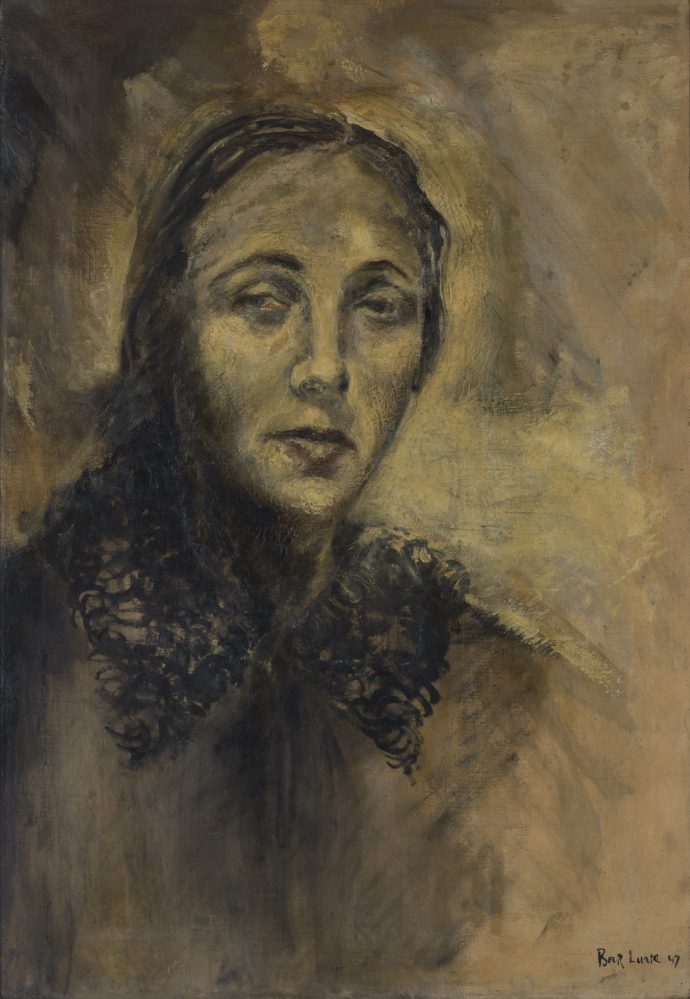
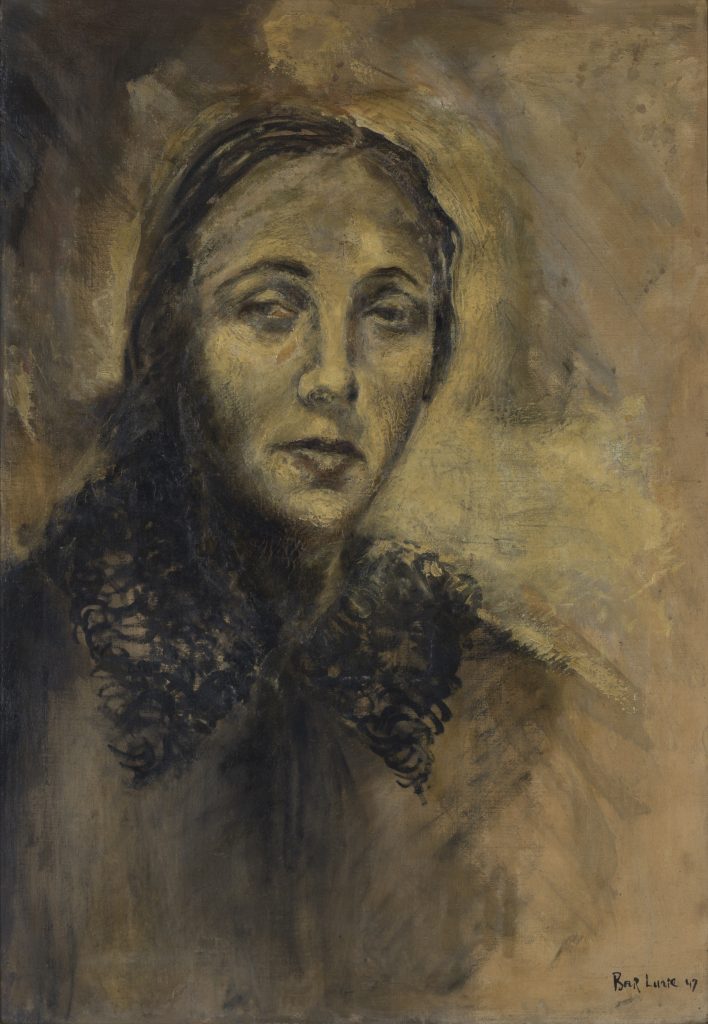
Lurie created his “War Series”in the immediate aftermath of the war, following his service with the United States Counter-Intelligence Corps and subsequent immigration to New York in 1946. In a society where most Holocaust survivors suffered in silence, he began creating artworks that he considered private. We can see in some of these early works that he is mourning his mother, grandmother, sister, and girlfriend. One of the most moving and evocative works in the exhibition is his Portrait of My Mother Before Shooting, done in 1947.
In nearly 100 paintings and drawings made, with few exceptions, in 1946, the “War Series”portrays Lurie’s experiences of the war in a highly graphic, expressionist style: nightmarish camp scenes in riotous colors, laborers at work in striped uniforms, stark landscapes cut through with barbed wire, amorphous dream-like visions, and searing portraits. One wall of the exhibit highlights his sadness, perhaps guilt, about what happened to his female family members and girlfriend. As suggested by their somewhat unfinished, chaotic style, Lurie considered these pictures a private catharsis, and never exhibited them in his lifetime.
These works are a far cry from his later much more public art, which is more familiar to people who know his artistic history. In 1959 he, along with Sam Goodman and Stanley Fisher, took over leadership of the March Gallery in New York. There they created the seminal Vulgar, Involvement, and Doom shows, and started a movement that would later be called NO!art. With the principle aim of bringing back into art the subjects of real life, the movement stood in opposition to the two most popular movements of the era, Abstract Expressionism and Pop Art.
Lurie was no longer afraid to portray sexual violence and humiliation as components of the Holocaust, in contrast to the early works shown in the Museum of Jewish Heritage. Remember the Women Institute’s 2018 VIOLATED! Women in Holocaust and Genocide exhibition displayed two such works: Untitled (Deliberate Pinup) and Untitled (Corset with Stars of David). In 1963, his now famous Railroad Collage, which superimposed a pinup girl in front of victims of a concentration camp, caused a major furor.
Included in the exhibition is Lurie’s only known self-portrait as a young man, in which he appears disembodied with a plaintive expression. There is also the exhibition’s largest masterpiece—a ghostly concentration camp scene, 50 by 50 inches in scale, painted in 1971 after the original “War Series” was made.