
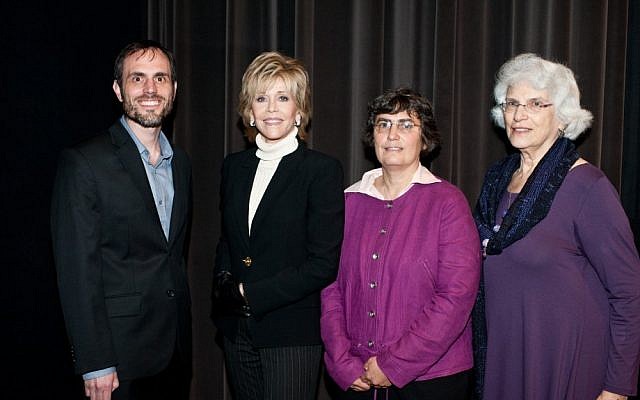
As a highlight of the two-day seminar on Sexual Violence during the Holocaust, Oscar-winning actress Jane Fonda hosted a public evening on Thursday, November 8, 2012, at the CAA Ray Kurtzman Theater in Los Angeles.
Ms. Fonda read excerpts from And the Rat Laughed, a novel by acclaimed Israeli writer Nava Semel, herself a child of Holocaust survivors. The novel, published in English in 2008, tells the story of a five-year-old Jewish girl who was sexually abused by Stefan, the son of Polish farmers who were hiding her from the Nazis. It takes place in the past, present, and future, and focuses on memory being transferred via the chain of generations from 1943 until 2099. This dramatic and moving reading left many audience members with tears in their eyes. It also inspired two Holocaust survivors in the audience to share their thoughts. Ms. Fonda also introduced a clip reel from the USC Shoah Foundation’s archives, specially made for the occasion by USC Shoah Foundation and Remember the Women Institute. In this interview segment, a woman who had been raped by a Nazi guard at Auschwitz-Birkenau testified about her experience and urged others to come forward.
The event was co-sponsored by Remember the Women Institute, the USC Shoah Foundation, and Equality Now. Following Ms. Fonda’s presentation and the clip reel, there was a panel discussion with Jessica Neuwirth, founder and president of Equality Now, Dr. Rochelle G. Saidel, founder and executive director of Remember the Women Institute, and Dr. Stephen Smith, executive director of the USC Shoah Foundation. This program was the culmination of an historic symposium on Sexual Violence during the Holocaust on November 7-8, 2012, during which invited participants discussed whether we can actually still find primary testimony and how to make victims’ voices heard; how we can research and compile for scholars the citations of sexual violence already available in published works; and how we can endeavor to ensure that sexual violence is included in the Holocaust narrative for future generations.