
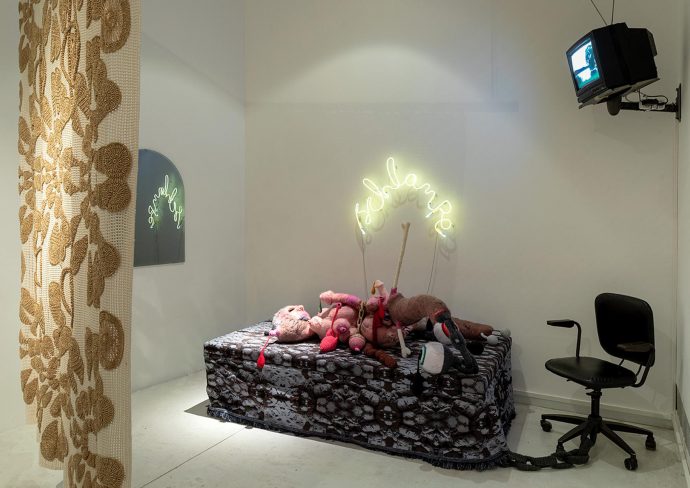
“Soft Body/Hard Truth Discussion” was part of the Kibbutz Buchenwald exhibition by Gil Yefman and Dov Or-Ner at the Tel Aviv Museum, Israel
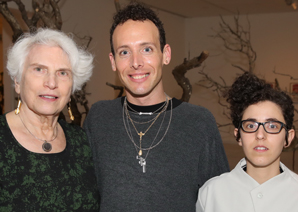
Dr. Rochelle G. Saidel, founder and director of the Remember the Women Institute, and Dr. Diddy Mymin Kahn, founder and director of the Kuchinate Collective, offered an evening of conversation as part of the Kibbutz Buchenwald exhibition. Moderator was the exhibition curator, Adi Dahan. Artist Gil Yefman has worked with both our institute and Kuchinate. Before the conversation, Yefman and Dov Or-Ner led a tour of the exhibition.
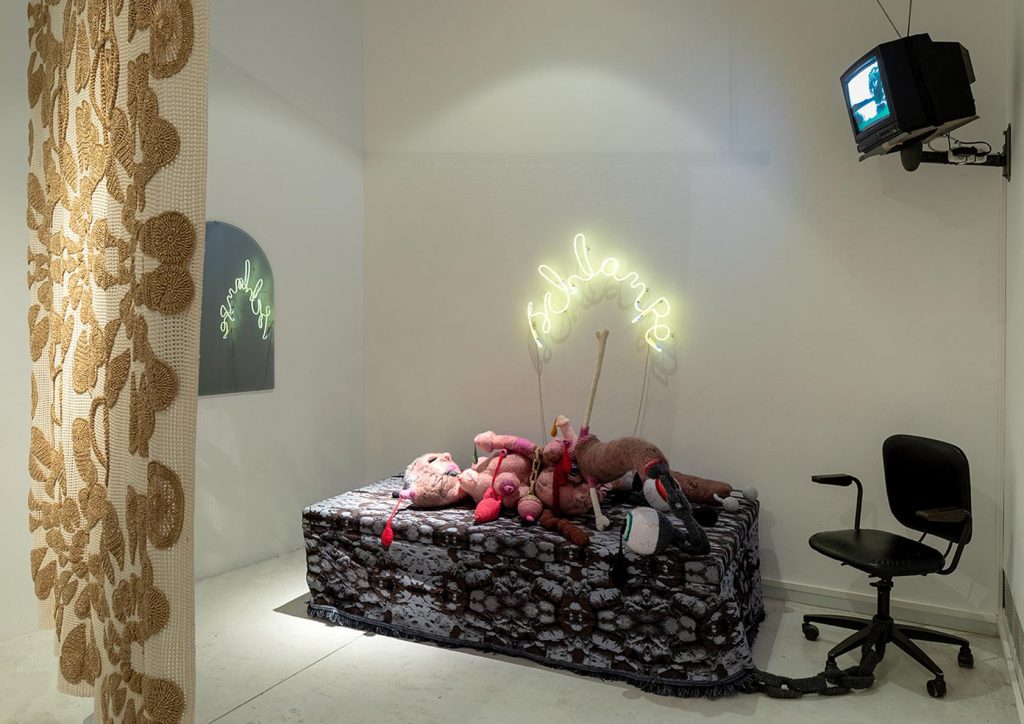
As part of the exhibition, a small room in the gallery featured Yefman’s crocheted sculpture of a forced sex slave at a Nazi concentration camp, a newer version of his sculpture last shown in April-May 2018 at the Ronald Feldman Gallery in New York, a highlight of Remember the Women Institute’s VIOLATED! Women in Holocaust and Genocide exhibition, curated by Dr. Batya Brutin. Both of these life-size sculptures, lying on beds, allowed Yefman to become part of them so that viewers connect not only with the grotesque abused women, but also with the artist’s striking blue eyes. The wall text and catalog for this new artwork recognize the research by Dr. Sonja M. Hedgepeth, Dr. Rochelle G. Saidel, and Remember the Women Institute as background on the topic of forced sex workers in Nazi concentration camps.
“Through the motif of cultivated nature emerges an imagined, fantastic, queer and mystic site-that is, kibbutz Buchenwald.”
TEL AVIV MUSUEM PRESS RELEASE
This exhibition presents a new project that develops Yefman’s collaborations with the artist Dov Or-Ner and the Kuchinate collective. The centerpiece of the exhibition is a video installation, Bad Renro and Penelope at Kibbutz Buchenwald, which Yefman made with Israeli artist and Holocaust survivor Dov Or-Ner. The video installation revisits a short-lived historical event that took place from the end of World War II until the early years following the establishment of Israel. According to the museum’s press release, “It considers the rift that opened between ‘Holocaust’ and ‘revival,’ evokes collective traumas and offers ways of unison. Through the motif of cultivated nature emerges an imagined, fantastic, queer and mystic site — that is, kibbutz Buchenwald.”
The film follows two characters, Penelope embodied by Gil Yefman, and Bad Renro (looking a lot like Hitler) embodied by Dov Or-Ner. Dressed as Penelope and Bad Renro, the two artists stage performance art at the Buchenwald Nazi concentration camp memorial, the Netzer Sereni kibbutz (formerly Kibbutz Buchenwald) in Israel, and the Holocaust memorial monument at the kibbutz, created by the Zionist sculptor Batya Lishanski.
The museum press release states: “The work’s title relates to a short historical event in which a group of survivors from Buchenwald concentration camp sought to implement a communal ideology and realize a productive and collective future from within the anarchy that was the end of World War II. The survivors chose a name that indicated the place they met and formed as a group — kibbutz Buchenwald. Yet when they arrived [in Israel] to carry out their shared vision, the kibbutz movement had difficulty accepting such an anomalous phrase. The name evolved and survived for four years before its current name was decided — kibbutz Netzer Sereni. The original name, loaded with a rare possibility of remembrance, slipped away from the historical canon.” The press release concludes: “Zionism and Holocaust remain explosive subjects of fervent preoccupation that still shapes local identity, defines morals and tradition, ranges between delicate familial feelings and the politics of public sentiment.”
Yefman collaborated with the women of the Kuchinate collective to crochet the leaves for a living fence entitled Hedgerow at the entrance to the gallery. The leaves are evocative of the foliage the Nazis placed in front of the Birkenau gas chamber and incinerators to hide them from the imminent victims. Yefman also collaborated with these refugee women from Africa, now living in Tel Aviv, to crochet huge baskets for the VIOLATED! exhibition. By working with them, he recognizes both their crocheting skills and their victimhood. “The mute nature allows Yefman to transform the building blocks of Israeli society, to pick at the wounds of memory, to gaze at them with eyes wide open and to plant new seeds in them,” according to the museum’s press release.
Read background information about the original Kibbutz Buchenwald, organized by Holocaust survivors in Germany after liberation. Judy Tydor Baumel-Schwartz, daughter of one of the organizers, Director of The Arnold and Leona Finkler Institute of Holocaust Research and related research institutes at Bar-Ilan University, and a member of the Advisory Board of Remember the Women Institute, wrote a book about this history.