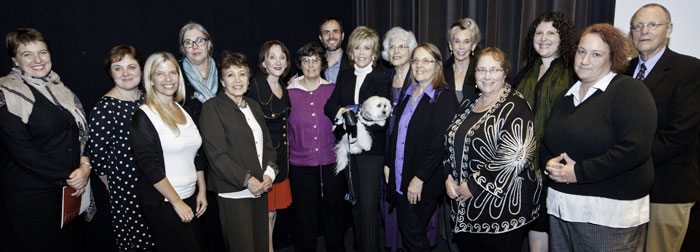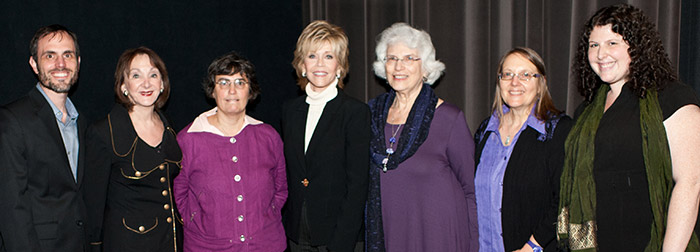
A historic symposium on sexual violence during the Holocaust took place on November 7-8, 2012, in Los Angeles, co-sponsored by the Remember the Women Institute and the USC Shoah Foundation. The meeting of some 20 invited academics and activists who have worked on this issue was held at University of Southern California. The symposium was prompted by the publication of the book Sexual Violence Against Jewish Women During the Holocaust (eds. Sonja M. Hedgepeth and Rochelle G. Saidel), which breaks new ground in exploring the evidence that has been overlooked or ignored by mainstream Holocaust scholars for the last 65 years. It is also an outgrowth of Remember the Women Institute’s project to seek living survivors of sexual violence during the Holocaust who will be willing to testify. USC Shoah Foundation has over 1,700 testimonies that refer to sexual assaults in all stages of the Holocaust — from ghettos to camps, and from forced marches to DP camps.
Over these two days, participants reflected on the types of evidence that point to sexual violence, the place of sexual violence within genocidal processes, and the ways in which genocide is shaped by gender. For example, workshops and presentations discussed the role of testimony in understanding sexual violence in the Holocaust, the credibility of testimony as a primary historical source, how the Holocaust and other genocidal experiences are gendered, how understanding the role of sexual violence informs Holocaust historiography, and how shame has played a role in survivors’ willingness to share the story.
After two days of deliberations the participants drafted a group statement of purpose for going forward, which says:
Evidence, information, and scholarship are emerging that sexual violence, long largely ignored, was an integral part of the Holocaust in many forms. Absence of acknowledgment of this reality has not only harmed survivors but also the understanding of and efforts to prevent genocide, and efforts to stop sexual violence in genocide, war, and every day. We hope that increasing awareness of this subject, obscured by shame and denial, will bring recognition to the victims, many of whom did not survive, rectify this omission from history, and support the work of those who oppose these atrocities.
The list of participants (alphabetical order) is:
- Patrice Bensimon
- Dr. Paula David
- Dr. Richard Dekmejian
- Dr. Monika Flaschka
- Dr. Eva Fogelman
- Dr. Myrna Goldenberg
- Dr. Wolf Gruner
- Dr. Sonja Hedgepeth
- Dr. Karen Jungblut
- Dr. Dan Leshem
- Dr. Catharine MacKinnon
- Daisy Miller
- Jessica Neuwirth
- Dr. Amy Parish
- Dr. Andrea Peto
- Dr. John Roth
- Dr. Rochelle Saidel
- Karen Shulman
- Dr. Stephen Smith
- Dr. Elisa von Joeden-Forgey
- Dr. Zoe Waxman