
Dr. Rochelle G. Saidel
Remember the Women Institute is marking our 25th anniversary in 2022. In honor of this milestone, as the founder and executive director, I am reflecting on the institute’s beginning and my inspiration for its creation. This is an updated version of a background essay about my grandmothers that I wrote for the original website, combined with an essay I wrote after my mother died in 2016.
HOW IT ALL BEGAN
Ravensbrück Women’s Concentration Camp
My own work on women and the Holocaust began in earnest in 1980, after I visited the memorial site of Ravensbrück women’s concentration camp, then in the German Democratic Republic (East Germany or GDR). As I have written elsewhere, this memorial – what was there and what was NOT there – deeply moved me. Most of us living in the United States at that time, including me, had never heard of this women’s camp behind the Iron Curtain. And more than anything, the memorial was a Communist shrine until after the curtain fell in 1989. I had been invited to the GDR to write articles about the Jewish community there for the Jewish Telegraphic Agency. Much later I learned that the ulterior motive was to encourage trade between the United States and the GDR (probably with the Jews and power myth behind it). Ravensbrück was not on the agenda, but at the urging of Aviva Cantor, I insisted on being brought there. Accompanied by a survivor who had been a Communist political prisoner in the camp, I was shown some of the horrors and monuments. Knowing little but sensing that something seemed left out of her descriptions, I finally asked: weren’t there any Jewish women in this camp? She answered that Olga Benario Prestes, a Communist hero, was also Jewish.
Afterward, I decided to begin to research the question of Jewish prisoners in Ravensbrück. The job became much easier after 1989, when the memorial moved west without budging an inch. But even then, people who should have known better discouraged me and said there was no Jewish story. Unfortunately, my uninformed hunch in 1980 was correct, because I discovered that an unknown number of the camp’s victims, close to 20,000, were Jewish. I began interviewing survivors, doing intense research, and returning to the memorial. And the result was my book, The Jewish Women of Ravensbrück Concentration Camp, published in 2004 (delayed by a diversion to complete my PhD dissertation on another subject in 1992). During the research for the book, which began in earnest after 1992, the Remember the Women Institute was born. Much of the inspiration began with my interest in Ravensbrück.
FEMALE ROLE MODELS IN MY FAMILY
I would be remiss if I didn’t thank the women in my family who came before me for serving as role models. They didn’t march with the Suffragettes or burn their bras, but they overcame challenges and provided a loving and encouraging environment for my own intellectual growth and endeavors. Let’s begin with my grandmothers. Especially in this time of tragic displacement in Ukraine, I have to thank them (and my grandfathers) for having the courage as young adults to leave Eastern Europe for frightening and unknown futures in the United States. And I know that I was lucky to have grandparents, and to have them geographically nearby. All of our mothers and grandmothers have life stories that, in one way or another, can inspire us and also contribute to our better understanding of women’s history. Here I will mention mine.
Esther Feigel Ovchinskas (Hoffman) Saidel
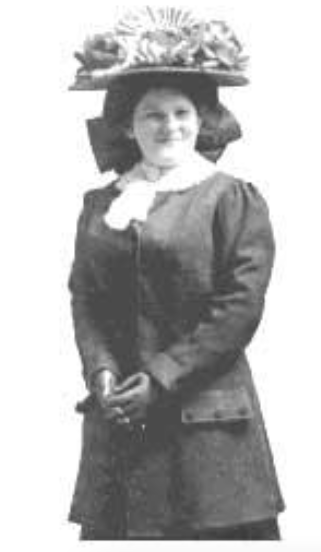
My paternal grandmother, Esther Feigel Ovchinskas (Hoffman) Saidel, is wearing a hat that she created herself. She arrived in the United States in 1908, from Kopcheva, Suvulk Province, Lithuania. Esther came to the United States with the family of her aunt, Peshe Similinska (Seaman) Miller. She married Samuel Saidel, and they lived in Glens Falls and Bolton Landing, New York. She worked as a skilled seamstress, then in the family’s general store, and then as an active partner in the family’s summer resort business. She sewed, knitted, and crocheted creatively and exquisitely, and also took great pleasure in her flower gardens. The mother of three children – Joseph Saidel, Leatrice Saidel Russ, and Dr. Frank Saidel – Esther died in 1959 at the age of 67. She and my doting grandfather lived around the corner from us in Glens Falls, and I spent summers with them at the resort. Despite our close relationship, she never spoke of losing her father, siblings, and their children during the Holocaust. Years after her death, her only surviving niece made Aliyah from Vilna and told us about her family’s murder in Lazdei and Kovno.
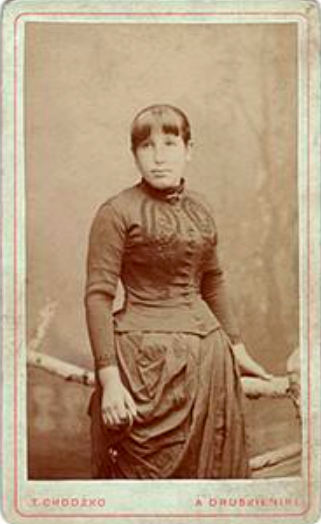
Esther’s mother, Yenta Similinska Ovchinskas, was married to David Ofchinskas, and they had eight children (in order of their birth): Esther, Raisel, Hirsch, Berl, Chaim, Devora Rifka, Ruchel, and Leizer Falk. Yenta died before Esther left for the United States with her mother’s sister’s family in 1908, and this surviving photo is all that I know about her. Raisel, Hirsh, and Berl were murdered at Katkishok (outside of Lazdei), along with David, Yenta’s husband. Leizer Falk was murdered in Kovno in the Ninth Fort. Chaim disappeared in Mexico. Ruchel died before Katkishok—but her stone does not seem to be in the Kopcheva Jewish cemetery now. Devora Rifka, my grandmother’s sister, was buried in Kopcheva in 1924 and the stone still stands there.
Ida (Chaya Sarah) Ellen Levine
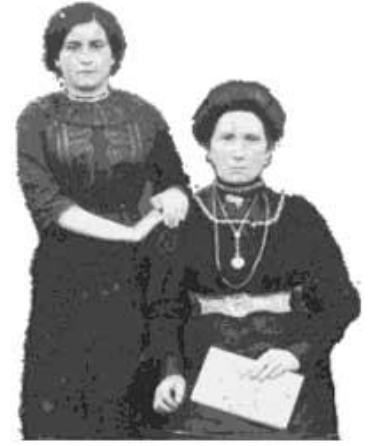
Ida (Chaya Sarah) Ellen Levine, my maternal grandmother, is shown (left) with her mother Mindel Ellen. They arrived in the United States from Lomza, Poland at the beginning of the twentieth century. They first joined Chaim, Mindel’s husband and Ida’s father, on Division Street on the Lower East Side of New York City, then moving to Schenectady, New York. Ida married Meyer Levine in 1914 and they lived in Schenectady for most of their lives. For many years Ida helped to support the family by working in their small grocery store. She was a working mother who lived behind the store and took care of the business and the household at the same time. The mother of two children – Florence Levine Saidel and Leonard Levine – Ida died in 1984, at the age of 89. She was a link with “the old country,” Eastern Europe before the Holocaust, for her children, grandchildren, and great grandchildren.
Florence L. (Levine) Saidel, 1915-2016
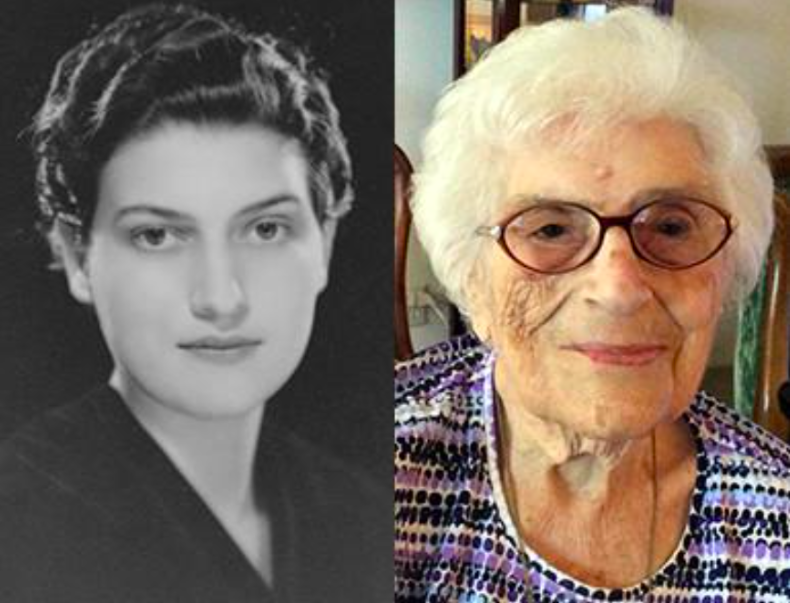
Right: Florence L. Saidel, 2015.
My mother Florence L. (Levine) Saidel died peacefully on July 30, 2016, less than two months before her 101st birthday. She was born in Schenectady on September 17, 1915, to Ida and Meyer Levine, Jewish immigrants from Poland. After marrying in 1937, Florence and her husband Joseph Saidel, my father, lived in Glens Falls. They then made their home in Albany, New York, and she lived there for nearly 50 years.
My mother had a fulfilling life in a changing world. When she was growing up in Schenectady, her father sold fruit and vegetables from a horse-drawn cart, and by the time she died, she was communicating with her grandchildren and great grandchildren via the internet. Her only sibling, her younger brother Leonard Levine, died in Albany in 1986. My parents met while my father was studying at Union College in Schenectady. She liked to recall that she was only fourteen at the time they met, but told him she was sixteen, as he was “a college boy.” However, he had graduated early from Bolton Central School in Bolton Landing and was then only fifteen.
From that meeting came a romance that led to their marriage after my father graduated from law school in 1937. The couple settled in Glens Falls, his birthplace. My sister Mindy Mangot, my brother David Saidel, and I were born and raised there. (I was the oldest.) During that time, my mother was a traditional full-time wife and mother, preparing lunch and dinner to serve her family every day of the week. She was also active in the local Hadassah chapter and the Sisterhood of Congregation Shaarey Tefilah. During the summers, my parents were part of the family hotel business, Twin Pines on Trout Lake, in the Town of Bolton.
My parents moved from Glens Falls in 1966, after my father gave up his private law practice and began working in the New York State Law Department. This required some adjustment on my mother’s part, after decades of ties with a close circle of friends and family in Glens Falls. But she succeeded in building a new life in Albany, making good friends and enjoying nearby family that included two local grandchildren (my children), Esther and Daniel. She also worked until she was 82 years old in the Senior Adult Department of the Albany Jewish Community Center. She was active in the Upper New York State Region of Hadassah, and made several trips to Israel. Meanwhile, she also continued her traditional role as a homemaker for her husband. This role become more difficult after he began suffering from dementia, but she never stopped lovingly taking care of him until he died in 1997.
My mother lived alone after that, until she needed the help of caregivers after falling in 2011. She was grateful to celebrate her 100th birthday at a party with family and friends in September 2015. Thanks to the loving support of her family and a group of devoted caregivers, she was able to remain in her own home until the last week of her life. Author Meika Loe included my mother’s advice for aging gracefully in Aging Our Way: Lessons for Living from 85 and Beyond, 2011.
P.S. Joseph Saidel
Even though this essay is about my foremothers, I would be remiss if I didn’t include my father’s role in my journey to creating an institute to include women in history, as well as authoring related books. Although he was an Orthodox Jew, he believed that women were equal to men, and he always encouraged me. For example, when he learned that I was going to be given the honor of lifting a Torah at my egalitarian Conservative synagogue, he explained how to physically do so correctly. When I lost patience with preparing the index for my first book, he took over the task for me. He was always proud of my achievements, and would have been pleased to know that Remember the Women Institute was born the same year that he left us.