
Love It Was Not is an Israeli documentary about a Jewish prisoner in Auschwitz and her Nazi officer lover.
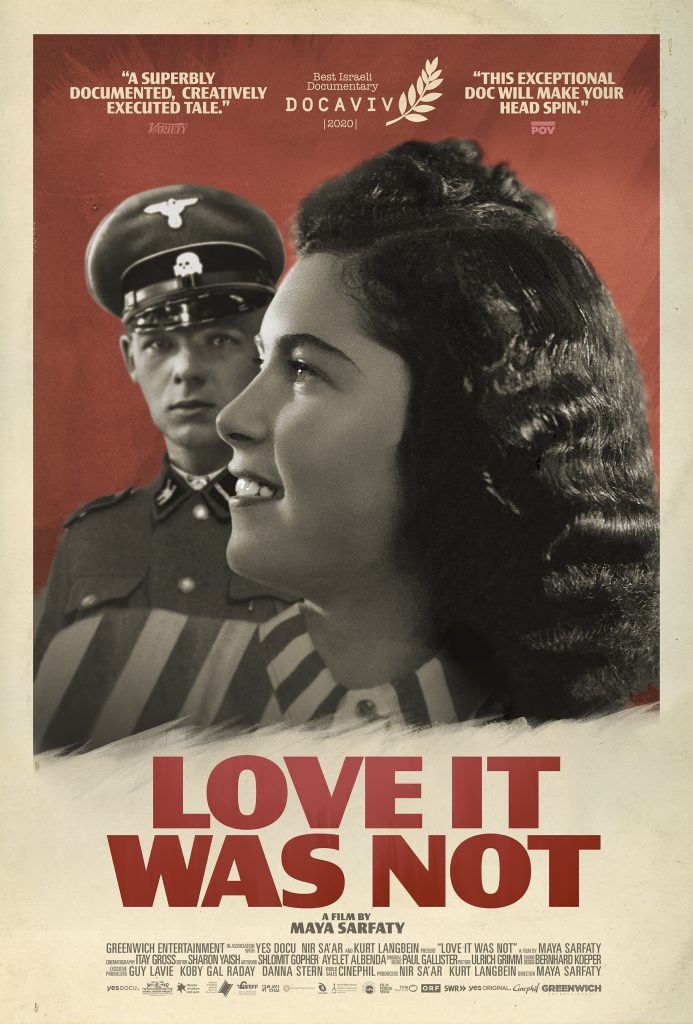
Helena Citron was one of some 999 Slovakian young women transported to Auschwitz on the first official Jewish transport, and her singing attracted the attention of SS officer Franz Wunsch.
Maya Sarfaty’s 2021 “Love It Was Not” started out as a student film and ended up winning prizes. Nominated for best documentary at the Ophir Awards, the Israeli equivalent of the Oscars, the film tells the true story of SS officer Franz Wunsch’s love for Helena Citron, a pretty and talented Jewish Auschwitz inmate. Her feelings for him are an unanswered question.
The story evolves among the gas chambers, crematoriums, and blood red skies of Auschwitz-Birkenau. When the older Wunsch heard Helena sing a German song of the era with the refrain, “It was not Love,” he was immediately attracted. Helena recalled how the prisoners “very quickly became animals.” She worked in Kanada, where the women sorted out the belongings of those who had been murdered in the gas chambers. Wunsch, in his relationship with Helena, was kind and protective. When Helena was sick with typhus, he hid her and nursed her back to health. Unlike the other starving prisoners she was well-fed.
When he asked her to sing, he said “please,” as she later recalled. The nature of their relationship that lasted for more than two and half years is never specified as sexual but she admitted to a kiss at liberation. “I had feelings for him at that point,” she said. Wunsch tried to track her down for many years afterward, but Helena had married, was living in Israel, and had two children. Thirty-five years after the liberation, Wunsch’s wife contacted Helena, begging her to testify on his behalf at a war crimes trial in Vienna. Some people in Israel considered her a collaborator, but her relationship with Wunsch had saved many lives.
Moving back and forth in time, the film offers viewers old letters, archival footage, home movies, and black and white photos. Helena, who died in 2007, is interviewed toward the end of her life. We also see her with her sister Roza on an earlier Israeli talk show. Because Helena had been able to have Wunsch rescue Roza from the gas chamber, but not her young children, Roza had never forgiven her.
We don’t hear as much from Wunsch, who died in 2005, or really know what his life was like after World War II. He speaks in the film as a much older man seated in a chair in front of his suburban home. People who knew Helena and Wunsch offer their opinions in the film, speculating on Helena’s motivations. Some of Helena’s fellow prisoners even admitted their jealousy or hatred. While some didn’t blame her, others continued to hold her in contempt.
At Wunsch’s trial in Vienna, Helena bears witness to both his good and evil. She addresses this directly, and refuses to make eye contact with him. He is acquitted in the end, and we learn that no SS guard was ever convicted of war crimes in Vienna. Thus Helena’s testimony really didn’t make a difference. (In Hebrew with English subtitles)
See reviews of the film at https://forward.com/culture/477744/love-it-was-not-maya-sarfaty-franz-wunsch-helena-citron-documentary-film/ and https://reformjudaism.org/blog/film-review-love-it-was-not.